



The Republic of Serbia is a sovereign state organised as a parliamentary republic. Its political system is based on representative democracy, the rule of law, the separation of powers, political pluralism, and the protection of human and minority rights.
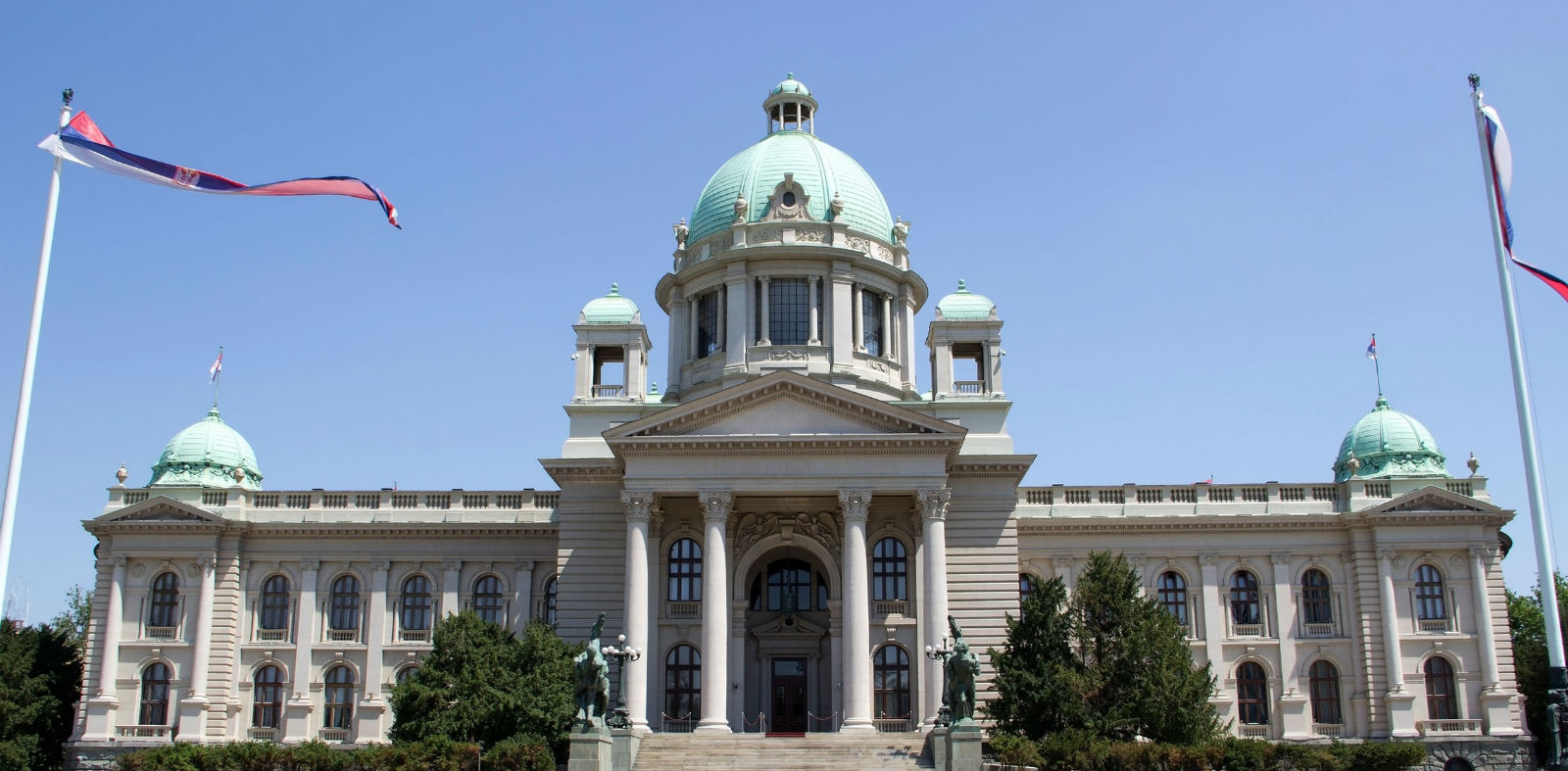
Citizens exercise sovereignty through elections, referendums, popular initiatives, and freely elected representatives. National institutions are centred in Belgrade, the capital and seat of the National Assembly, the President of the Republic, the Government, the Constitutional Court, and other principal state bodies.
The present constitutional framework is based on the Constitution of the Republic of Serbia adopted in 2006. Constitutional amendments concerning the judiciary were approved in a referendum in 2022.
The Constitution
The Constitution is the highest legal act of the Republic of Serbia. All laws, regulations, decisions, and actions of public authorities must comply with it.
It defines Serbia’s fundamental principles, territorial organisation, state institutions, division of powers, human and minority rights, economic system, and procedures for amending the Constitution.
According to the Constitution, Serbia is a state founded on the rule of law and social justice, the principles of civil democracy, human and minority rights and freedoms, and a commitment to European principles and values.
The Constitution also establishes Serbian as the official language and Cyrillic as the official script. The use of other languages and scripts is regulated by law and is recognised in areas where national minorities traditionally live.
Separation of Powers
The political system of Serbia is based on the division of state authority into three branches:
- Legislative power, exercised by the National Assembly
- Executive power, exercised primarily by the Government, with the President of the Republic performing duties defined by the Constitution
- Judicial power, exercised by independent courts
The three branches are intended to balance and supervise one another within the limits established by the Constitution and the law.
Independent institutions, including the Constitutional Court, the Ombudsman, the Commissioner for Information of Public Importance and Personal Data Protection, the State Audit Institution, and other regulatory bodies, also contribute to oversight, legal protection, and institutional accountability.
The National Assembly
The National Assembly is Serbia’s highest representative body and the holder of constitutional and legislative power.
It is a unicameral parliament composed of 250 deputies elected directly by citizens through secret ballot. Parliamentary elections are held under a proportional electoral system, and deputies generally serve a four-year term unless the Assembly is dissolved earlier in accordance with the Constitution.
The National Assembly:
- Adopts and amends the Constitution
- Passes laws and other general acts
- Adopts the state budget and reviews its implementation
- Elects the Government and supervises its work
- Elects or appoints certain public officials in accordance with the Constitution and law
- Ratifies international treaties when required
- Decides on war and peace
- Exercises democratic and financial oversight over public institutions
Parliamentary work takes place through plenary sessions, committees, debates, questions to the Government, public hearings, and the consideration of draft legislation.
The Assembly elects its president, vice-presidents, and working bodies from among the deputies.
The President of the Republic
The President of the Republic represents Serbia at home and abroad and expresses the unity of the state.
The president is elected directly by citizens through secret ballot for a five-year term. The same person may not be elected to the office more than twice.
The president’s constitutional responsibilities include:
- Representing the Republic of Serbia
- Promulgating laws adopted by the National Assembly
- Proposing a candidate for prime minister after consultations with representatives of elected political lists
- Calling parliamentary elections in circumstances established by the Constitution
- Appointing and recalling ambassadors upon the Government’s proposal
- Granting pardons and awarding state honours
- Commanding the Serbian Armed Forces in accordance with the law
The president may return an adopted law to the National Assembly for reconsideration. If the Assembly adopts it again, the president is required to promulgate it.
Although elected directly, the president does not lead the Government. The Government is responsible for directing national policy and is accountable to the National Assembly.
The Government of Serbia
The Government is the principal holder of executive power and is responsible to the National Assembly.
It consists of the prime minister, one or more deputy prime ministers, and ministers responsible for different areas of public administration. The precise number and organisation of ministries are determined by law and may change when a new government is formed or the administrative structure is reorganised.
The Government:
- Determines and directs domestic and foreign policy
- Executes laws and other acts adopted by the National Assembly
- Proposes laws, the state budget, and other measures
- Adopts regulations necessary for implementing laws
- Directs and coordinates the work of public administration
- Represents the Republic of Serbia in areas within its competence
- Manages public policy and responds to the National Assembly for its work
A candidate for prime minister presents the Government’s programme and proposed ministers to the National Assembly. The Government takes office after receiving the support of a parliamentary majority.
The Government’s term is linked to that of the National Assembly, although it may end earlier following resignation, a vote of no confidence, or other circumstances prescribed by the Constitution.
Public Administration
Public administration implements laws, prepares regulations, performs professional and administrative duties, maintains public records, and provides services to citizens and businesses.
It includes ministries, administrative bodies within ministries, special organisations, agencies, and other institutions established by law.
Public administration is expected to act lawfully, professionally, transparently, and in the public interest. The expansion of electronic government services has enabled many procedures, applications, registrations, and payments to be completed online.
The Judicial System
Judicial power in Serbia belongs to the courts, which are constitutionally defined as independent in their work.
The court system includes courts of general jurisdiction and specialised courts. Courts of general jurisdiction deal with civil, criminal, family, labour, and other matters, while specialised courts cover areas such as commercial and administrative disputes.
The Supreme Court is the highest court in the Republic of Serbia.
Judges are required to decide according to the Constitution, laws, ratified international treaties, and other applicable regulations. Their independence is intended to protect judicial decisions from political or other external influence.
The High Judicial Council is an independent state body responsible for safeguarding the independence of judges and courts and performing duties defined by the Constitution and law.
Public Prosecution
Public prosecution is responsible for prosecuting criminal offences and protecting the public interest in cases prescribed by law.
The prosecution system is headed by the Supreme Public Prosecutor and includes higher, basic, and specialised public prosecution offices.
Public prosecutors are expected to perform their duties independently, based on the Constitution, laws, ratified international treaties, and other applicable regulations.
The High Prosecutorial Council is an independent state body intended to protect the autonomy of public prosecution and perform responsibilities established by the Constitution and law.
The Constitutional Court
The Constitutional Court is an independent state institution that protects constitutionality, legality, and fundamental rights.
It determines whether laws and other general acts comply with the Constitution and whether lower-level regulations comply with the law. It also resolves certain disputes between state institutions and decides on constitutional appeals submitted by individuals who believe that their constitutionally guaranteed rights have been violated by public authorities.
The Constitutional Court is not part of the ordinary court system. Its decisions are final, enforceable, and generally binding.
Elections and Political Parties
Serbia has a multiparty political system. Citizens elect representatives at the national, provincial, and local levels, as well as the President of the Republic.
Elections are based on universal and equal suffrage and are conducted through direct and secret voting. Serbian citizens who meet the legal requirements generally acquire the right to vote at the age of 18.
Deputies to the National Assembly are elected through a proportional system. Political parties, coalitions, and citizens’ groups may submit electoral lists, while special rules support the representation of national minority parties.
The President of the Republic is elected under a majority system. If no candidate receives the required majority in the first round, the two candidates with the highest number of votes proceed to a second round.
Political parties operate freely within the constitutional order. Their organisation and activities must comply with the Constitution and law, and the Constitutional Court may prohibit organisations whose activities threaten constitutional principles or protected rights.
Autonomous Provinces
The Constitution provides for two autonomous provinces: the Autonomous Province of Vojvodina and the Autonomous Province of Kosovo and Metohija.
Vojvodina, situated in northern Serbia, has its own provincial assembly, government, administration, budget, and other institutions. It exercises autonomous responsibilities in areas established by the Constitution, national legislation, and the provincial statute.
Kosovo has been under international administration since 1999 and declared independence in 2008. Serbia does not recognise the declaration, while Kosovo’s status remains disputed internationally. The actual institutional and political situation therefore differs from the framework defined by the Constitution of Serbia.
Local Government
Local self-government enables citizens to manage public affairs of direct importance to their communities.
The principal units of local self-government are municipalities, cities, and the City of Belgrade. They have elected assemblies and executive bodies and perform duties defined by the Constitution and law.
Local authorities are responsible for areas that may include urban planning, local roads, public transport, utilities, environmental protection, culture, primary education, social services, local economic development, and other community matters.
Responsibilities and financial resources vary according to the type and size of the local government unit.
Human and Minority Rights
The Constitution guarantees a broad range of civil, political, economic, social, and cultural rights.
These include equality before the law, protection from discrimination, freedom of expression, freedom of assembly and association, freedom of religion, the right to a fair trial, protection of personal data, property rights, labour rights, access to education, and participation in public life.
Serbia is a multiethnic country whose Constitution protects both individual and collective rights of national minorities. Minority communities may exercise rights relating to language, script, education, culture, information, and the official use of their languages in areas where legal conditions are met.
National minority councils represent minority communities in areas such as culture, education, information, and official language use.
State Symbols
The state symbols of the Republic of Serbia are its flag, coat of arms, and national anthem.
The Serbian flag is a horizontal tricolour of red, blue, and white. The state flag also displays the national coat of arms.
The coat of arms features a white double-headed eagle, a shield with a cross and four firesteels, and a royal crown. Although Serbia is a republic, the crown is retained as a historical symbol of Serbian statehood.
The national anthem is Bože pravde, with lyrics adapted from a nineteenth-century composition by Jovan Đorđević and music by Davorin Jenko.
Serbia celebrates Statehood Day on 15 February, known as Sretenje. The date commemorates the beginning of the First Serbian Uprising in 1804 and the adoption of the Sretenje Constitution in 1835.
Key Facts About Serbia’s Political System
Form of government: Parliamentary republic
Highest legal act: Constitution of the Republic of Serbia
Constitution currently in force: Adopted in 2006
Legislative body: National Assembly
Number of deputies: 250
Parliamentary term: Four years
Head of state: President of the Republic
Presidential term: Five years, with a maximum of two terms
Principal holder of executive power: Government of the Republic of Serbia
Highest court: Supreme Court
Voting age: 18
Capital and seat of national institutions: Belgrade